Introduction
The Hook: Beyond the OpenAI Partnership
For years, Microsoft’s AI identity was inseparable from its partnership with OpenAI. While this collaboration gave the Redmond giant a massive head start, the tide is shifting. With the launch of its proprietary line of models, dubbed “MAI” (Microsoft AI), the company is reaching a pivotal milestone: strategic autonomy. Microsoft is no longer content being just a distributor for GPT-4; it is now building its own digital brains. This transition signals a move from strategic dependence to total technological sovereignty.
At the heart of this revolution is Mustafa Suleyman, the DeepMind co-founder recruited to lead Microsoft AI. His mission is clear: to build a layer of “in-house” foundational models that can rival the world’s best while being perfectly optimized for Microsoft’s infrastructure.
This new range is powered by Foundry, a cutting-edge platform designed to provide enterprises with unprecedented computing power and flexibility. Suleyman’s objective goes far beyond simple transcription or image generation; he is aiming for “Superintelligence.” By natively integrating MAI models into tools like Teams, PowerPoint, and Copilot Voice, Microsoft is not just adding features—it is installing a proprietary ecosystem that is faster, cheaper, and fully integrated.
Section 1: MAI-Transcribe-1 – High-Performance Transcription at Half the Cost
The first pillar of Microsoft’s new AI suite is MAI-Transcribe-1, a model specifically engineered to tackle the most common frustration in speech-to-text technology: accuracy in unpredictable environments.
1. Technical Resilience: “Hearing” Through the Chaos
Unlike traditional transcription models that require studio-quality silence to function effectively, MAI-Transcribe-1 was built for the noise of everyday life.
- Mastering Degraded Conditions: The model excels in scenarios that typically cause AI to fail—crowded coffee shops, low-bandwidth 4G calls, or frantic meetings with multiple overlapping voices.
- Native File Versatility: By supporting MP3, WAV, and FLAC out of the box, it removes the need for time-consuming pre-conversion, preserving audio fidelity and streamlining developer workflows.
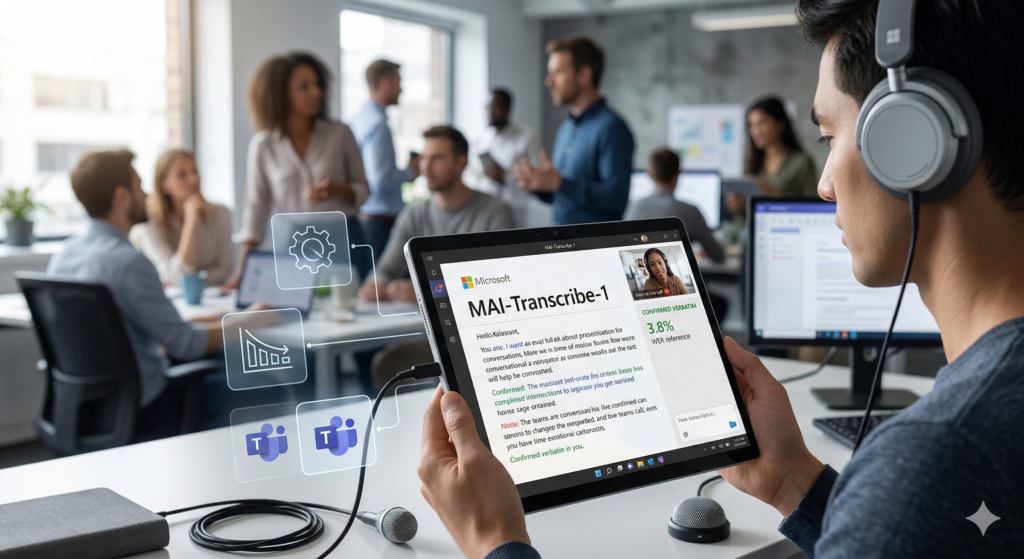
- Global Precision: With a Word Error Rate (WER) of just 3.8% across 25 languages, it consistently outperforms industry benchmarks like Whisper-large-v3, particularly in complex acoustic settings.
2. The Economic Edge: High Performance, Half the Cost
Mustafa Suleyman made a bold statement by revealing that the GPU cost for this model is two times lower than other leading models.
- Infrastructure Optimization: This isn’t about cutting corners; it’s about efficiency. The model is 2.5x faster than the previous Azure Fast service, allowing it to process massive amounts of data with less energy.
- Market Disruption: At $0.36 per hour, Microsoft is aggressively undercutting competitors. For a corporation processing thousands of hours of call center data or legal meetings, this represents a monthly saving of tens of thousands of dollars.
- Hardware Synergy: By optimizing the model to run on Microsoft’s own Azure infrastructure, the company reduces its reliance on the rarest, most expensive AI chips, securing better margins and reliability for its clients.
3. Native Integration: A Seamless User Experience
Microsoft’s greatest strength is its distribution power. MAI-Transcribe-1 isn’t just an isolated API; it is already the “hearing system” for the tools you use daily:
- Copilot Voice: It enables near-instant vocal interaction, eliminating the awkward processing delays that often plague AI assistants.
- Microsoft Teams: It powers real-time conversational transcription, capable of generating hyper-accurate summaries even during heated, fast-paced debates in video conferences.
- Developer Ready: Through Foundry and the AI Playground, developers can test and integrate this power into their own third-party apps with just a few clicks.
Section 2: MAI-Voice-1 – Redefining the Speed of Sound
If MAI-Transcribe-1 serves as the “ears” of Microsoft’s new ecosystem, MAI-Voice-1 acts as its “voice.” This model represents a massive leap forward in text-to-speech (TTS) technology, prioritizing two factors that have historically been at odds: extreme speed and emotional consistency.
1. Lightning-Fast Performance: Zero-Latency Generation
The most striking feature of MAI-Voice-1 is its sheer velocity.
- The “1-Second” Rule: The model is capable of generating 60 seconds of high-fidelity audio in less than one second.
- Real-Time Interaction: This near-instantaneous processing power is critical for the next generation of AI assistants. It eliminates the “robotic pause” typically found in voice bots, making conversations with AI feel as fluid and responsive as talking to a human.
2. Instant Voice Cloning: Your Voice, Digitized in Seconds
Microsoft has simplified the once-complex process of professional voice cloning.
- Minimal Samples: MAI-Voice-1 can create a highly accurate “voice double” using only a few seconds of audio recording.
- Identity Preservation: Despite the short sampling time, the model captures the unique nuances, cadence, and timbre of the speaker. This allows businesses to create personalized brand voices or for individuals to maintain their vocal identity across digital platforms without hours of studio recording.
3. Unmatched Consistency for Long-Form Content
One of the greatest challenges in AI synthesis is “vocal drift”—where a voice begins to sound different or loses its emotional tone during a long reading.
- Stable Delivery: Microsoft indicates that MAI-Voice-1 maintains vocal identity perfectly over extended periods. Whether it is a 2-minute briefing or a 2-hour audiobook, the voice remains steady and natural.
- Foundry Integration: This stability makes it an ideal tool for content creators, educators, and developers looking to automate long-form narration through the Foundry API.
4. Aggressive Market Positioning
Microsoft isn’t just competing on technology; it’s competing on cost.
- Disruptive Pricing: Priced at $22 per million characters, MAI-Voice-1 is positioned as a significantly more affordable alternative to current market leaders.
- Scalability: By lowering the barrier to entry, Microsoft is encouraging wide-scale adoption for everything from localized video game characters to automated customer service agents in dozens of languages.
Section 3: MAI-Image-2 – Driving Commercial Creativity at Scale
The final piece of the current MAI trifecta is MAI-Image-2. While its predecessor laid the groundwork, this second iteration is built for professional-grade performance, focusing on the two things businesses value most: speed and commercial reliability.
1. Doubling the Speed of Creation
In the world of generative AI, latency is the enemy of productivity. Microsoft has addressed this head-on:
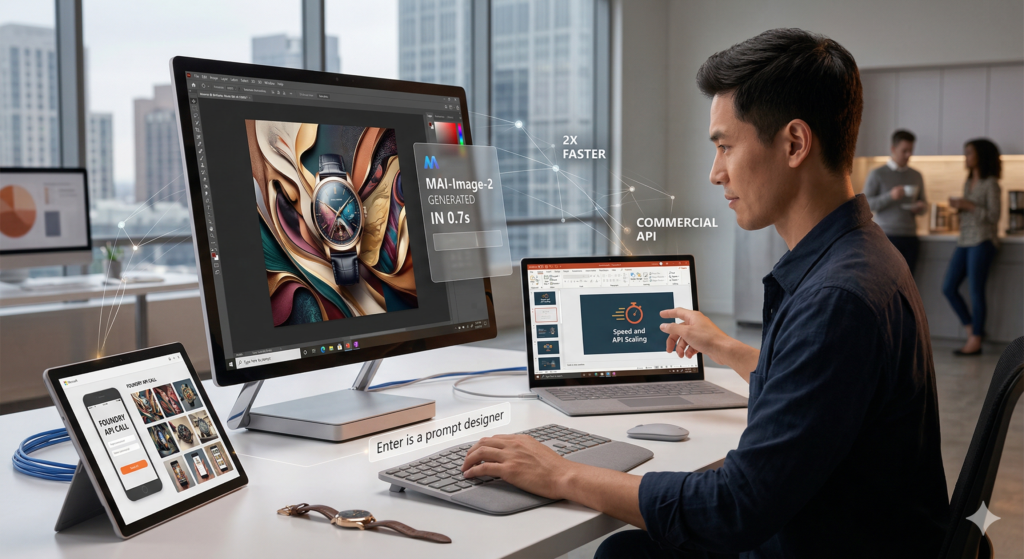
- 2x Faster Processing: MAI-Image-2 is at least twice as fast as the previous version. This allows for near-instant rendering of complex visual concepts.
- Frictionless Workflow: This speed boost is particularly noticeable in “live” environments—such as brainstorming sessions or social media management—where waiting for an image to generate can break the creative flow.
2. Commercial Readiness via Foundry API
Unlike many experimental models, MAI-Image-2 is built for business.
- Direct API Access: The model is now fully open for commercial use via the Foundry API. This means developers and enterprises can integrate high-end image generation directly into their own products, apps, or marketing platforms.
- Cost-Effective Scaling: With a pricing model of $5 per million input tokens and $33 per million output tokens, Microsoft provides a transparent and competitive structure for companies looking to generate thousands of assets daily.
3. Deep Integration: From Bing to the Boardroom
Microsoft isn’t just selling an API; it’s upgrading its entire software suite.
- PowerPoint Revolution: The model is currently being rolled out within PowerPoint, allowing users to generate custom, high-quality illustrations for their slides simply by typing a description. This turns every user into a competent visual designer.
- Bing Enhancements: As part of the progressive deployment, Bing’s creative tools are becoming more responsive and capable of handling more intricate artistic styles, making high-end AI art accessible to the general public.
4. Accuracy and Coherence
Beyond speed, MAI-Image-2 focuses on spatial intelligence. It shows a marked improvement in following complex prompts—such as specific text placement or intricate human anatomy—which has historically been a weak point for many diffusion models.
Section 5: The Grand Strategy – Achieving Independence from OpenAI
The launch of the MAI suite is far more than a simple product update; it represents a tectonic shift in Microsoft’s long-term corporate strategy. For years, the tech world viewed Microsoft as the “junior partner” in the AI race, providing the cloud (Azure) while OpenAI provided the brains (GPT). That era is officially ending.
1. The Suleyman Era and the Quest for Superintelligence
The turning point occurred in late 2025 with the appointment of Mustafa Suleyman to lead the newly formed Microsoft AI division. Suleyman didn’t just bring his DeepMind pedigree; he brought a singular, radical focus: Superintelligence.
- A Dedicated Mission: Suleyman’s recent statements to The Verge confirm that building internal proprietary models is now his “sole objective.”
- Vertical Integration: By building its own foundational models, Microsoft is following the “Apple Playbook”—controlling both the hardware (Azure AI chips) and the software (MAI models) to ensure maximum efficiency and profit margins.
2. Strategic “Latitude” and the New OpenAI Partnership
A key part of this story is the subtle but significant renegotiation of the Microsoft-OpenAI partnership.
- Freedom to Compete: This new agreement has granted Microsoft the “latitude” to conduct its own internal R&D in parallel with OpenAI’s work.
- From Exclusive to Multi-Model: While Microsoft still distributes OpenAI and Anthropic models through its ecosystem, it is no longer bound by an exclusive “GPT-or-nothing” strategy. This diversification protects Microsoft from potential disruptions at partner companies and gives them immense leverage in future negotiations.
3. Building a Proprietary Foundational Layer
Since the launch of MAI-Image-1 in October 2025, Microsoft has been aggressively accelerating its autonomy.
- The Layered Approach: Microsoft is building what Suleyman calls a “proprietary layer of foundational models.” These models are designed to be “good enough” for 90% of business tasks (transcription, voice, basic imagery) at a fraction of the cost of high-end LLMs like GPT-4o.
- Reducing “The OpenAI Tax”: Every time a user interacts with a model, there is a cost. By switching users to internal MAI models for tasks like Teams transcription or PowerPoint image generation, Microsoft keeps that revenue entirely in-house.
4. What This Means for the AI Market
Microsoft is positioning itself as the ultimate AI Architect. They are no longer just a “landlord” for other people’s AI; they are the creators.
- Control over the Stack: By owning the models, Microsoft can iterate faster, update more frequently, and offer pricing that competitors—who have to pay for third-party API access—simply cannot match.
The Verdict: Microsoft is playing the long game. While they will likely remain OpenAI’s biggest supporter for the most advanced reasoning tasks, the MAI suite proves that for everyday productivity, Microsoft is ready to stand on its own two feet. This is the birth of a sovereign AI superpower.